Wikipedia has been a cornerstone of the Internet since its inception as, for better or worse, a prime example of the online dissemination of information. It provides an immense corpus of data on innumerable subjects open to anyone with internet access, but it is subject to editorial controversy and undergoes continual change and revision. For complicated subjects, like this article on Digital Humanities, it is important to understand how the site works and how these articles come to be.
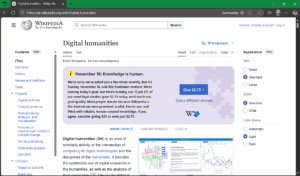
In order to navigate these inner nuances, Wikipedia offers several tools to parse the site’s structure, the first of which being the Talk page of an article. This serves as a kind of forum for editors to discuss important topics for revising, rearranging, editing, trimming, or any other kinds of changes to the article at hand. For example, this exchange details a discussion on altering the ‘Criticism’ section of the article:
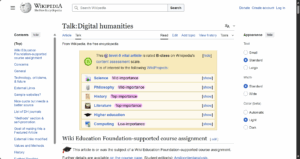
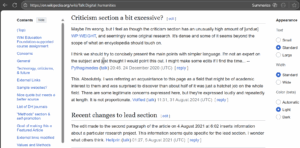
By using the Talk page, users can see which topics were brought up for discussion, which were controversial or problematic, which were added or removed or reorganized, and more. It essentially shows how the editors deliberated the current form of the article, and why they did so. In addition to the Talk page, the History page shows the entire edit history of the article from its creation (in this case, in 2007) to its current form.
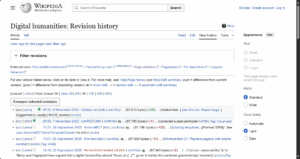
This page also demonstrates important areas of editorial activity, spread across the timeframe of the article’s growth as things, such as citations and external links, are added and removed. By viewing this page, users can see which editors and contributors were involved in specific parts of the article and between which time frame they were active, allowing for a transparent view of who exactly is involved in the development of the article. Moreover, the History page naturally illustrates when certain things were changed to the article, as well as the order in which information was added, changed, or removed, oftentimes based on developments in the field for such a complicated subject as Digital Humanities.
Naturally, deconstructing a Wikipedia page, especially an informationally dense one as this, showcases how volatile the presentation of facts and knowledge can be on an open-access site such as Wikipedia. The biographies of contributors can vary widely, and the rate of changes can be rapid, making Wikipedia both an effective and cautious purveyor of information. Its unparalleled role on the Internet has made way for its new role in training AI models to crowdsource information, which opens some possibilities alongside exacerbating the existing challenges facing Wikipedia. In the reading, Jon Gertner states that none of his sources think that it is possible “to build a good A.I. model without Wikipedia,” citing its near-monopoly as an open database of knowledge, but the more it is used this way, the more likely problems will occur for both ends of the relationship (Gertner 40). Using A.I. to disseminate Wikipedia’s wealth of information not only overshadows the latter (especially when the A.I. does not cite its sources), but it carries the existing problems of Wikipedia’s editorial veracity; the A.I. can easily repeat false information spread by an unknowledgeable or malicious Wikipedia contributor. Despite the safeguards that Wikipedia attempts to maintain against malefactors, there are numerous issues that can plague both attempts at crowdsourcing information, and the above two tools illustrate that there are human elements of controversy and debate just as much as those relevant to A.I. itself. Hence, it is important to consistently understand how to deconstruct the source of one’s knowledge from origins such as Wikipedia or an L.L.M.; knowing how their answers came to be, whether through editorial debate or elsewise, will become increasingly necessary amidst the digital dissemination of knowledge.
Sources:
https://www.proquest.com/docview/2840654056?accountid=14541&parentSessionId=CB4k0B8dg5RppuRBpKekW03Dk9oY3BBua3DwOL3oLpQ%3D&sourcetype=Magazines