DPH Internship: Post 2

As I am now further into my internship experience, having finished a first draft of my project and worked about fifty hours in total, it is largely following along to my early expectations. In general, it is not surprising to me that my favorite part of the experience is working with primary sources and researching historical content. Searching through archived sources, digitized court documents, and other materials is certainly part of why I am pursuing education in History. Furthermore, using these sources to write digital content is another enjoyable aspect that I was hoping to get out of this experience. It is one thing to learn history for my own sake, but it is another to have an opportunity to share history with an audience to help them learn. As I have explained prior in this program, I want to work in a field where I can constantly help others engage in historical content and help encourage similar loves for learning as my own. Thankfully, this internship is providing me an enjoyable foundation to do that work. In the next few weeks, I will be pivoting more towards the digital element of the project, where I will be creating the electronic exhibit itself. I estimate that this will be a less enjoyable aspect of the process than the research and writing portion, but I plan on trying my best while keeping in mind how much of an important learning experience it is.

Thinking about these experiences thus far, I want to try to make use of this program’s opportunity as much as I can during this next year. The internship I am working on is giving me a valuable framework for how history can be used in various occupations and other educational circumstances. While I am greatly enjoying this project, it is mainly building on skills that I already know. Therefore, I want to see how I can best network and increase my collaborative and teamwork experience. In the meantime, I intend to see how effectively I can perform in an individual-scale project like this one so that I have a basis for expanding my experience in the next internship. Regarding my own work style preferences, it has not been too difficult to fit this internship in with graduate school and my other work. I have found it very effective to devote between three to five hours on specific days, where I can fully focus on this internship work in set periods. In fact, these intervals have provided a nice respite from other work because I can consistently enjoy interacting with the content. Otherwise, as I explained above, this internship is largely building on my existing skills, so I will need to see if I have to adjust my usual style in the coming weeks.

DPH Internship: Post 1

For my internship in this program, I am working with the Fairfax County Judicial Learning Center to create a digital exhibit on important court cases from the county’s history. The Judicial Learning Center is a part of the Fairfax County Circuit Court Historic Records Center which is heavily involved in local educational programs. From the Center’s website, their stated mission is using sources from the archives to foster public awareness about how the local judicial system functions and its historic role in American civil rights history. Their overarching emphasis is on education for middle- and high-school groups. So far, I have mainly been introduced to the individuals that I will be contacting in the Center, while doing some personal background research into the event as a whole – the internship largely starts this week. For my part, I am pleased that I am still able to utilize my interests in English/literary history for this research prompt.

Although I do not have an official ‘role’ in the organization itself, I am a remote intern who will work with the Center’s staff and resources to create content for them. As with some of the other online exhibits created by History students, I will be in constant contact with the Center to research, write, and create a digital exhibit on some high-profile cases in Fairfax County history. Specifically, I will be writing about a civil rights case involving library censorship in the 1960s, which will demonstrate how the local court approached concerns of supposed ‘subversive’ media and libraries’ freedom to engage the public. Naturally, this is in line with the Center’s mission of educating the public about important civil-rights history within the local court system: my exhibit will demonstrate how places of communal importance, namely libraries, can be besieged by adverse social forces (in this case, the Red Scare) as well as showing how they can defend against them in the interest of the public good. When it is finished, my exhibit will join the other examples of important civil-rights cases in the history of Fairfax County, illustrating the role of the judicial branch in these developments.

Overall, my main learning goal is to understand how to truly apply the skills I have been studying in this program so far. Heretofore, the program helped me apply my undergraduate studies in History and English into specific skillsets for the Digital Public Humanities field. Chiefly, I want to be able to fully apply my research and writing skills for larger-scale projects that involve teamwork and coordination. I have already learned how to use certain digital tools like Voyant and Omeka for my own personal projects, so I hope to use this opportunity to gain experience in applying them in a team-based, professional setting. The most important aspect of this opportunity for me is using these skills for a specific professional goal, which is the mission of the Judicial Learning Center. When this internship is finished, I hope that my contribution will be educationally valuable.

DPH Summer: Presenting the Past

Much has already been said in this course about the challenges and uncertainties facing the Humanities, but the development of our digital age has provided enormous opportunities for engaging with the past at the same time. After all, with regards to the larger history of information and its curation throughout the ages, it cannot be understated how fundamentally electronic tools changed things. Possibly the greatest advantage of digital tools is the unprecedented level of accessibility. The advent of the internet has especially facilitated incredible access to all kinds of uploaded information – however, the scope of this access is of course limited to what is uploaded onto the internet and how it is curated. A perfect database of human knowledge is naturally impossible to achieve, but the digital frontier still provides an opportunity for humanities-oriented people, especially historians, to employ the skills that they have always used in curating such information. Using Wikipedia as the foremost example, Brown and Olsen describe it as “a useful forum to communicate such complexities to the public, as well as an effective tool for future historians to improve their academic abilities.” As with their example of using it to engage with the history of Tiananmen Square, digital repositories like Wikipedia allow for a wide public engagement with history which depends on the effort and input of its contributors. The shortcomings implicit in often-anonymous contributors nonetheless opens more opportunities for engagement by opening the door for many additional perspectives and contributions. In the reading, Sadie Bergen posits that the “way historians tell history is in some basic ways incompatible with Wikipedia” due to its encyclical nature, but this only emphasizes the need for wider engagement with its topics to alleviate implicit biases. Like with past curation of history, the societal biases and perspectives of its creators are imbedded in Wikipedia’s framework, but its digital nature means that it is far more open to debate, modification, and adaptation, and it is important to make this fact more widely known. That so much information about the past can be widely available only underscores the necessity to teach why it matters and how to engage with it. Large-scale accessible encyclopedias like Wikipedia are only one example; digital tools provide an enormous variety of new ways at approaching and interpreting the past. The ease and relative freedom of sharing information itself makes teaching history smoother, but a wider range of contributions greatly helps both individuals and groups engage with the past. Wineburg reminds readers that “What once fell on the shoulders of editors, fact-checkers, and subject matter experts now falls on the shoulders of each and every one of us,” describing the increased sense of responsibility individuals have in parsing digital information, but this challenge for veracity itself should keep students and the public continuously engaged with our shared past. The more we keep people involved in recording, reviewing, and adding to the past, the better we can engage with its contents in and outside the classroom.


References

Bergen, Sadie. “Linking In: How Historians are Fighting Wikipedia’s Biases.” Perspectives on History (blog). September 3, 2016.

Brown, Jeremy and Olsen, Benedicte M. “Teaching Tiananmen: Using Wikipedia in the Undergraduate Classroom to Learn How to Write about Recent History.” American Historical Association. April 2012

Wineburg, Sam “Why Historical Thinking is Not About History.” History News 71, no. 2. 2016.

DPH Summer: Fifth Piece of the Puzzle

Approaching the final stretches of the course, my project remains a hybrid research analysis of Modernist authors (between 1914-1930) and their experience during or after WWI. I have slightly limited the scope of authors to simplify the project, but I have still ensured a solid variety of writers to choose from. The intended audience is a standard classroom of undergraduate college students pursuing majors in either History or English (or a hybrid class between them like some that I took), and the purpose is to illustrate the important role of literary history in understanding the past, while also providing practice in historical thinking and academic research. Beyond the classroom, however, I believe that the foundation of this project is not too dissimilar to what one would read in a typical biographical museum exhibit, so I think the audience could be extended. But other than the scope and purpose, the project’s current state consists of a large amount of notes, chosen excerpts, and primary sources from my own research. My immediate next step is to organize these into the project assignment itself. The sample student examples from the prior module were a great help at visualizing what the project could look like digitally, so I imagine that mine would take a similar shape using WordPress or another format. Another one of my next steps is to think about how I want to guide students through this kind of assignment; it is one thing to have the entire idea in my head, and another to help standard college undergraduate students walk through the process of historical thinking. Naturally, this week’s discussions on artificial intelligence compelled me to think about how to design my assignment with the AI-age in mind. At first I wanted to somehow completely ‘AI-proof’ my project, but given its continued development I do not think that would bear much fruit, and as the readings concurred, it is just yet another electronic tool of our digital age. I am already planning on incorporating such a tool in Google Maps, so instead I have been thinking on how to focus better on the students’ experience. As with the overarching goal of the project, I want to help the hypothetical students practice approaching complicated research questions and how to formulate an argument using sources and analysis, so teaching them how to ask effective questions is important. In this regard, AI has not so much altered my opinion on research questions so much as it has reinforced it – AI models still cannot provide the kinds of inquisitiveness that is central to this project, so I hope to show students how to do so themselves.

DPH Summer: Consuming and Creating Media

As a student of history, I have engaged with historical films for both classwork and enjoyment, and I would certainly want to utilize them in my own educational work. I was inspired to fully watch and review David Lean’s Lawrence of Arabia because my thesis advisor showed certain scenes in a Middle Eastern history class, and used those depictions as a basis for classroom discussions on both the content and the film’s portrayal of it. I think I would take a very similar approach: introduce the content and the context of the film, and guide students through several different facets of the film, including narrative and cinematography. For example, students could discuss whether it matched their expectations from earlier lessons, whether they found its portrayal of the content convincing, or what they would change instead. An important element of this activity would be analyzing the film as a medium – students would need to inquire how the film was made, why it might have made certain decisions, and what specific information or sources it was based on. This would hopefully utilize several different aspects of historical thinking to teach students how to better approach films as a medium to convey information and perspectives, with its advantages and disadvantages. For this review, I was initially considering more traditional ‘war’ movies, but for future activities I think I would lean more into historical biopics similar to Lean’s Lawrence due to the breadth of material they provide for discussion.

Of course, film is just one example of digital (or otherwise electronic) storytelling and the educational opportunities it offers. Digital tools provide new ways of finding, organizing, interpreting, and communicating information of all academic kinds, but they also assist in finding a bigger audience for such information. For the past century, cinematography has been an enormously influential medium to convey history to an ever-growing public – for good and for ill, with reliable research or not. As digital tools evolve, so too will the possibilities of digital storytelling, and new mediums will provide alternate ways of engaging with history. Writing a decade ago, Robert Whitaker’s proclamation that “video games will prove to be one of the most popular mediums of the 21st century” was extremely prescient, and so too was his prediction that the gaming public is an immensely important audience for the humanities to connect with (“Backward Compatible”). As the industry has continued to exponentially grow since then, more and more video games utilize historical content and settings, and even more than that, numerous genres have emerged where in-game histories are multilayered enough to merit interpretive discussion. In my experience, many of the skills integral to historical thinking are utilized in these discussions, which is often the intent by developers. Thus, Whitaker is correct that the gaming public is an audience that public historians cannot ignore going forward – video games are themselves prime examples of digital storytelling, and it will be interesting to see them referred to more in classrooms.

Regarding more educational applications of digital storytelling, I think I would take a similar approach to those seen in the modules where most research questions are left up to students. Similar to my own current project, I envision students finding their own niche within the broader scope of the lesson for them to individually pursue and fulfill. From the reading, Sample and Schrum explain that digital storytelling has value because “it is accessible, relatively easy to teach basic technical skills, and a useful practical skill,” and similar to their own examples of scaffolding techniques, I think that a larger degree of freedom would be best suited to help students succeed in such a project (“What’s Right with Digital Storytelling”). In doing so, I think students would obviously improve at research, source analysis, and writing as well as other staples of historical thinking, but it would also teach them much about the relationship between interpreting historical sources and using them to convey a narrative. Like with film, the power of these mediums is not that they can relate a multitude of historical ‘facts’ (which itself would be suspect) but that they can convey them through powerful narratives for different kinds of people, which requires responsibility and the utmost care. Practice with digital storytelling would help students in both creating narratives and approaching those of others.


References:

Zemon Davis, Natalie. “Film as Historical Narrative.” In Slaves on Screen: film and historical vision. Cambridge, Mass.: Harvard University Press, 2000.

Robert Whitaker. Backward Compatible: Gamers as a Public History Audience Perspectives on History

Schrum, K. (2012). A tale of two goldfish bowls . . . Or what’s right with digital storytelling. In D. Cohen & T. Scheinfeldt (Eds.) Hacking the academy: A book crowdsourced in one week. Ann Arbor, MI, University of Michigan Press.

DPH Summer: Film Review

Film: Lawrence of Arabia. 1962. Directed by David Lean. Produced by Sam Spiegal and Horizon Pictures. Distributed by Columbia Pictures. Accessed online via Amazon Prime Video.

A massive cinematic adaptation of Thomas Edward Lawrence’s autobiographical account of the Arab Revolt, The Seven Pillars of Wisdom, David Lean’s biopic Lawrence of Arabia provides one of the grandest-scale examples of history in cinema – to somewhat mixed results. From a cinematic and technical perspective, the film marks an important place in the history of film in the last century, and from a historical point of view, it sheds light on a moment in history that is immensely important but not nearly as publicly known as the rest of WWI: the Arab revolt against the decaying Ottoman Empire. The role of the titular character, T. E. Lawrence, is the focus of the narrative but the film as a whole portrays an incredibly wide swath of cultural and military history. Unsurprisingly, some levels of nuance and accuracy are lost in such a wide-ranging film, but even in the places where it is historically deficient, it is complemented by a consistently impressive visual depiction of its subject.

Because the film is weighted more as a biopic of Lawrence himself instead of an overarching depiction of the Arab Revolt as a whole, one of the central themes of the film is that of Lawrence’s character, which serves as a microcosm of British (and Allied) imperialism. As an officer in the British army stationed in Cairo, Lawrence is introduced as brilliantly charismatic in some ways and abrasively flippant in others, to the point that it is often difficult to parse his motives in any individual moment. Nonetheless, it is clear from the outset that his actions represent those of the British Empire whether he is consciously trying to act on them or subvert them. This dynamic is illustrated in his first council with Prince Faisal, the assuming heir apparent to a nonexistent Arab kingdom: Lawrence is ordered by Colonel Brighton to silently reinforce his claim that “British and Arab interests are one and the same,” but when Faisal provides him the opportunity, Lawrence wryly evades Brighton’s authority to denounce the British decision to retreat to Yenbo (49:00). Faisal’s ensuing dialogue about an inevitable European occupation in place of the current Ottoman one marks one of many similar political discussions in the film, which often leans more sympathetically to the Arabs, highlighting the British army’s hypocritical dismissal of the natives as a temporary means to use against their larger enemy. Lawrence’s private proclamation to Faisal that he is loyal “to England, and to other things” casts his motives in doubt – whether he is fully loyal to England, truly cares about the Arabs, seeking wealth and fame, or is only in it for orientalist adventure is not fully answered for much of the film (50:10). In a 1963 interview, Lean describes his depiction of Lawrence as “a very complicated character” that largely “depends on the viewer” – the most Lean is willing to divulge is that he sees Lawrence as “a man who had a fatal flaw in him, and if he’d been lucky, that flaw would not have been exposed… but it was exposed, and he could never forgive himself” (Interview 10:20). What that flaw is remains up to the viewer, and multiple conclusions can be made from the film not just for Lawrence’s character but those who he affects, especially the Arabs. Thus, the theme of Lawrence’s character is intertwined with the film’s other minor themes of colonial intervention and native resistance – to both the Ottomans and those who desire to take their place.

One of the most important scenes of the film that ties these themes together early on is the encounter at the Harith Well. After seemingly befriending his guide and learning how to adapt to desert travel, the calming assurance of water in a wasteland is cut short when its owner, Sharif Ali, arrives and kills Tafas for using it (at approximately 30:30). In addition to being Lawrence’s first personal introduction to Arabic relations, his own place as an outsider is quickly established, making way for the audience to witness how he tries to enter it. The pistol that Lawrence gave to Tafas as a gift, which he attempts to use against Ali, predictably falls straight at Lawrence’s feet upon death, highlighting the consequences his intrusion into the region will bring. Thenceforth the scene becomes an intimidating contest of wits between the two men, both framed as emblematic of their separate worlds: Lawrence, denouncing Tafas’ murder and making his (outsider’s) case for tribal unification; and Ali, demonstrating the importance of tribal identity and the evident limits of Lawrence’s familiarity with the region. Notably, Lawrence refuses to share his name, prompting Ali to refer to him as merely ‘English,’ reminding the audience of the larger imperial implications of Lawrence’s presence. Likewise, Ali is framed here to represent the wider, unknown society of the Arab tribes under Ottoman rule. He is shown to be more in control of the confrontation by taking and returning Lawrence’s compass – his only sense of direction – and introducing the realities of tribal politics by stating of Tafas that “he was nothing… the well is everything” (33:25). Despite the initial standoff, this scene provides the basis for their growing relationship across the film: they need each other for their aims, but the extent to which their goals truly align forms the tragedy underpinning a fleeting but genuine friendship. Hence, they are often depicted in a dualistic manner – Lawrence endowed with white robes and bright eyes to Ali’s black attire and darker gaze, and the fact that Ali is last depicted walking into complete darkness following the dysfunctional Arab council, while Lawrence is shown escorted through sunlight, seems to complete this picture (3:35:00). Though not explicitly shown, the audience can pick up from this framing that the Arab alliance will not remain in the ways that either Lawrence or Ali hoped, and the theme of colonial intervention seems to conclude in the inevitable breakdown of understanding. With Faisal and General Allenby taking the reins in negotiation, neither Lawrence nor Ali want a part in what comes next, having irreversibly fulfilled their roles in a global conflict.

Following the film’s intermission, a second key scene is the depiction of Lawrence’s leadership of a tribal coalition raid against an Ottoman train (at approximately 2:30:00). By this point, Lawrence has assisted in uniting two tribes against the Turkish stronghold at Aqaba and proven to British regional command the importance of continued Arab alliance, though Lawrence’s inscrutable character keeps the alliance in tension. Having secured further assistance by the British, the tribes’ guerilla campaign against the Ottomans begins in full, showcased by a brutal raid on a convoy train that highlights how this front of WWI was fought. Rather than the more character-centric scenes, the railroad raid conveys to the reader the realities of guerilla warfare and the politics that underpinned it. The scene opens with a view of the Arab forces lined with supplied weaponry atop a dune waiting for the opportunity to open fire, upon which the train’s soldiers are pelted with no thought for survivors. The footage of the shooting is repeatedly punctuated by reporter Jackson Bentley’s eager photography of the carnage, once again reminding the audience of the much wider implications of the conflict. Derailed and devoid of reinforcements, Lawrence gives the order to charge the train, which is revealed to have been carrying wealthy civilians rather than soldiers. As the Arab fighters scour the train, Lawrence is shown to grapple with the obscene reality of the scene, even refusing to shoot back at the lone surviving Ottoman soldier. Upon Bentley’s insensitive remark that he’d “never seen a man killed with a sword before,” Lawrence derides the reporter’s presence before reminding him to change his expectations of courtesy (2:34:00). In the aftermath of the attack, Lawrence appears to fluctuate between feelings as he often does with loyalties: despite leading the attack, he is visibly distraught by the carnage and the Huwaytat tribe’s immediate looting, as well as Bentley’s detached sense of exoticism regarding it all (which Lawrence himself may or may not still possess), but is able to immediately flip back into the assumed role of ‘Aurens’ and allows Bentley to take his picture atop the wreck, framing himself as the leader. That this scene was preceded with Bentley’s own deal with Faisal to help propagandize the war for a Western audience keeps the viewer aware of larger political implications, and the rest of the film continues to test Lawrence’s divided character. After experiencing torture from Ottoman forces and witnessing one of many massacres, Lawrence sheds the reservations shown in the train raid for a more brutal mindset that he ultimately comes to regret. The film’s further slide into the characters’ disillusionment is matched by increasing bloodshed, and by the end, the scene of the train raid still stands out as a key turning point.

With the major themes established within their key scenes, the film still remains a perplexing example of cinematic history. It is by no means completely historically accurate – as a biopic first and foremost, let alone one based on the subject’s own autobiography, it commits the sin of turning the narrative into a kind of vortex where everything surrounds the main character rather than placing them accurately into the historical record. Many characters in the film are composites of different real figures, most notably that of Sherif Ali. In her essay on adapting history in film, Natalie Davis lists as one of the things historians must make clear the notion that “historians should tell readers where they found their evidence and, when it is ambiguous or uncertain or contradictory, they should admit it” (Davis 10). While the film does not purport to tell an entirely accurate or dramatized depiction, Lean does greet the audience with a similar discussion. The film opens not with the beginning but with Lawrence’s untimely death in 1935, whereafter he is memorialized in the nation’s capital, where different people have very different opinions of the man. No one knows quite enough about him to offer much personal praise or disdain, even the same characters from later in the film (9:30). This early framing goes a remarkably long way (for a long film) in training the audience to question how they see the course of events. Although this may come at the expense of the film’s overall historical value, what is thankfully not lost is a sincere attempt at showcasing the cultures and societies key to the Arab revolt. The overall timeline of events is mostly accurate, and the film goes to great length at challenging both the imperialist aims of the Allied Powers as well as contemporary Western stereotypes about the region, even if, as critic Lawrence Raw posits, this comes at the expense of the film’s depiction of the Ottomans themselves, writing: “In their efforts to challenge orientalist representations of the Arabs, the screenwriters – like Lawrence himself – orientalized the Ottomans” (Raw 253). This criticism is compounded by some poor racial casting choices outside of O’Toole and Sharif’s roles, a remnant of the era.

In summary, it is not surprising that such a monumental piece of filmography would be rather difficult to fit into a history classroom discussion. The abovesaid criticisms of inaccurate dramatizations and questionable ethnic depictions blemish the historical accuracy, but the film still leaves open much room for valuable discussion and debate. From the reading, Davis explains that “Films can show—or, more correctly, speculate on—how the past was experienced and acted out, how large forces and major events were lived through locally and in detail” – the bulk of Lean’s film provides a valuable example of such speculation through the depiction of personal relationships and the overall vista of the early twentieth century Middle East (Davis 7). The various inaccuracies or oversimplifications are somewhat alleviated by the mostly correct depictions of the conflict itself, and both sides of this film allow for deeper discussion on the matter. Introducing this film into a hypothetical classroom, I would certainly make known some of the issues in its depictions, but I would want the students to question whether seeing this content put on film matched or challenged their notions of what this part of the war looked like culturally, militarily, and societally.


References

Lean, David (Director). Lawrence of Arabia. Horizon Pictures, 1962.

Zemon Davis, Natalie. “Film as Historical Narrative.” In Slaves on Screen: film and historical vision. Cambridge, Mass.: Harvard University Press, 2000.

Noteworthy Cinema. “Interview with David Lean 1963.” YouTube. 25 April, 2025. https://www.youtube.com/watch?v=fUNR8leWwao

Raw, Laurence. “T. E. Lawrence, The Turks, And the Arab Revolt in Cinema: Anglo-American and Turkish Representations.” Literature/Film Quarterly 33, no. 4 (2005): 252–61. http://www.jstor.org/stable/43797238.
DPH Summer: Third Piece of the Puzzle

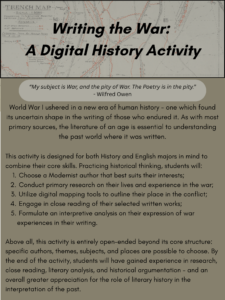
Having settled on a framework for a digital project, my main objective now is to compile the primary sources and materials that I want the project to incorporate. I already have plenty of research on WWI Modernist literature to draw from, so the larger problem is looking into research of the war to match the writers and authors I want to include. My preliminary list of writers includes Hemingway, Fitzgerald, Eliot, Owen, Sassoon, Kafka, Tolkien, Remarque, and some others if necessary; with some exceptions like Remarque, most of the list is English literature, which I will try to complement with other perspectives where I can. The written works by these authors will count as primary sources themselves, but I want to combine them with more ‘traditional’ sources of soldiers describing war experiences themselves, especially from the same places. Hence, as I am far more familiar with the literature angle, much of my immediate research will be focused on gathering and synthesizing WWI history and sources, keeping in mind all potential connections between them that I can apply to the hypothetical lesson. It will likely be a challenge balancing both halves of this project, but thankfully I already have experience in this subject to draw from.

National WWI Museum and Memorial | Collections Database

Another immediate objective has been to decide which digital tools and images to use. For the purposes of this project, many of the images included will likely be landscape photographs of the various spaces of the conflict, coordinated with specific writers. The above example, taken from the United States WWI Museum and Memorial digital archive, depicts a collapsed German bunker in the aftermath of the brutal Somme offensive. Some of the writers included in this project, namely J. R. R. Tolkien, served in this section of the war; although his work would likely be better compared with landscape photographs of the environmental consequences of the Somme, this example can be used to examine the nature of industrial conflict alongside other literary depictions of the trenches (especially Remarque’s). I chose this one because of its clear depiction of the trench, but there are others in the collection showing specific weapons or soldiers, which will still be available should students want to focus on those things. Regardless, I intend for the students to look at these types of image sources, map them to their corresponding geographic locations, and discuss the portrayal of the war in order to compare with examples from associated writing.

DPH Summer: Second Piece of the Puzzle

Thinking on my own project ideas, I want the focus to be synthesizing different literature texts surrounding World War I. Although I am still deciding on the specific content and interpretive angle, the subject matter opens up a lot of digital possibilities. For the actual literature itself I would ideally remain with physical texts, but the lesson could incorporate digital exhibits and collections from various museums regarding topics on the war and its corresponding writers. Of the tools that I have used for this course, I have not yet utilized digital mapping tools, but there could be potential use for a lesson centered on different experiences from the war and the writing they produced from those points. Seeing as I imagine my target audience to be a normal college classroom, similar to my undergraduate history classes, the majority of students would be natively familiar with digital tools and information, so finding a specific tool that engages them alongside physical texts would be paramount. Several museums that I have visited with WWI exhibits (especially the Kansas City National WWI Museum) have online components, so I imagine that those could serve as inspiration. Regardless of the exact tool I use, it must accentuate the role of interpretive discussion of the texts alongside their historic context; the discussions themselves would help with historical thinking, but so too should the content of the assignment itself.

DPH Summer: The History of Teaching History

It was interesting to reflect on this week’s reading alongside my own experiences in learning history, especially before I decided to pursue the field. In line with the question of external expectations about teaching, the conceptualization of history as merely a series of rote facts was always evident even when some curriculums tried to emphasize specific human elements, to the detriment of actual classroom engagement. Calder and Steffes note that unfortunately a common conception of history among the wider American populace is “what really happened, that is, a single, so-called right story of settled truths,” which is only true in an oversimplified sense that fails to account for the importance of historical thinking (“Measuring College Learning in History). Sam Wineburg’s criticism of traditional models of standardized testing underscores this academic sacrifice of deeper models of thinking in favor of easy-to-read multiple choice exams: “in addition to handicapping students who possess different historical knowledge from those in the mainstream, it means that no national test can allow students to show themselves historically literate” (“Crazy for History”). I can sympathize with the aggravation of seeing multiple-choice questions on topics that I am not well versed in while those that I am knowledgeable of get left out of the testing equation, and from Wineburg’s account of almost a century of poor testing results, I think this example can serve as a microcosm of how not to teach history effectively. Instead of trying to impart monumental amounts of information to students, much of the reading highlights how the processes of historical thinking are the foundations that history classes should be teaching at the minimum; although this kind of analytical thinking cannot be as easily measured by testing, it is fundamental to both history and overall critical thinking. Caldor and Steffes explain that knowing how to think historically “fosters critical thinking and analysis skills that are useful for work, citizenship, and individual efficacy,” adding that such a mindset ideally “fosters perspective taking and empathy, and, because it requires students to wrestle with the limits of knowledge, historical thinking is a training ground for solving problems when definitive answers are elusive” (“Measuring College Learning in History”). As with other skills, historical thinking extends beyond the classroom setting as an essential part of understanding one’s own historic position in time and space –  or an appreciation for how the past is fundamentally different, while inextricably connected to modern circumstances. Mills Kelly expounds on the applicability of historical thinking by explaining “Without the correct understanding of the nation’s past, the argument goes, our children cannot become the kinds of citizens we want and need for the future of our country… But in these debates factual knowledge is often conflated with correct understanding—we assume that if our children know the facts, they will understand the facts” (Chapter 1). From these excerpts, it is clear that the rote facts-based conception of history reinforced by these kinds of exams do not merely oversimplify history into an unchanging record of facts to be memorized, it also fails to inculcate critical thinking skills within students that effect far more than the history classroom.

While attempts at standardized testing have endured over the last several decades, the core elements of historical thinking have endured (in importance at least), and the possibilities offered by new digital tools have the potential to realign the history classroom in a better direction. Mills Kelly’s simplified list of common pillars of historical thinking, including source analysis, chronological thinking, evidence-based argumentation, and the fundamental understanding that the past is different and often conflicting, provides a solid grasp of the process itself, but their combined importance is conveyed by Calder and Steffes: “History is a constructed explanation made from fragmentary evidence that is always incomplete and subject to revision. Constructing these narratives, historians draw from a discipline situated at the intersection of humanities and social science, with a distinctive set of ideas and practices that guides how we interpret and use evidence, weigh and evaluate plausible explanations, and think about the past in relation to the present” (Chapter 1; “Measuring College Learning in History”). Far more than just a timeline of facts, history is a monumental collection of narratives, evidence, information, and perspectives that requires constant study and evaluation; to reduce it to a question with four potentially correct answers is a disservice to the immense human aspect in both understanding history and history itself. In modernity, mass communication is faster, easier, and more effective than ever before thanks to electronic media, and the digital forms in which information can be structured and shared are multitudinous, but these advances are met with dangers in understanding such a fast-paced environment. In many ways, the day-to-day navigation of this information sphere invokes historical thinking. Recalling the fallout from Carl Becker’s 1931 AHA speech, Edward Ayers explains that “Even more than in Carl Becker’s time, when powerful and seductive electronic technologies had begun to emerge, shared memories and private memories can easily fuse. Our private, interior history and the artificial memories that constitute history morph into one another, boundaries blur and disappear. Everyone has become their own historian, their own curator and archivist and narrator.” Then as now, historical thinking is imperative to understanding both oneself and one’s place in history – Ayers expounds that “The story of Mr. Everyman shows that we all do history every day, that we sometimes get it wrong, but that chastened by a reliable documentary record and the will to use it, we can come closer to the truth” (Everyone Their Own Historian). To return to the history classroom itself, it is essential to build this foundation of thinking and to convey why it is important, and digital tools provide ways of visualizing content that is not limited to non-engaging textbooks. The intersection of historical thinking and digital tools is summarized by Kelly, stating that the “best way to use digital media to teach them to see history as we see it is to create learning opportunities that make it possible for our students to do history—to practice it as we practice it—to help them make history, using their own creative impulses, rather than simply giving us what they hope is the correct answer to a question we have posed” (Chapter 1). This is how the best history classes I took operated, and thus it is the approach I hope to design my project around, as well as to carry into any potential classrooms in the future.


Sources

Ayers, Edward L. Everyone Their Own Historian. Journal of American History Volume 105, Issue 3, December 2018, Pages 505–513, https://doi-org.mutex.gmu.edu/10.1093/jahist/jay276

Kelly, T. Mills. “Thinking: How Students Learn About the Past” Chapter 1 in Teaching History in the Digital Age. 2013.

Wineburg, Sam. “Crazy for History” The Journal of American History 90, no. 4. March 2004.

Calder, Lendol, and Tracy Steffes. “Measuring College Learning in History.” Social Science Research Council. May 2016.