All posts by admin

Tracing the Letters of J.R.R. Tolkien

Tracing the Letters of J.R.R. Tolkien is a digital humanities project that aims to provide new methods of reading and understanding the main corpus of primary sources related to the titular author. One of the preeminent English writers of the past century, Tolkien’s letters illustrate a vast collection of the author’s insight into a myriad of matters – social, cultural, political, and, of course, literary. Through a text-mining approach with Voyant online software, this project organizes the letters into categorized data in order to sort through them for specific themes and issues related to his creative and writing processes as well as the ways in which Tolkien discussed them with different audiences. Specifically, the letters are divided between relevant letters to his family, his editors and publishers at Allen & Unwin, and his innumerable fans later in his career. Ultimately, this project seeks to aid Tolkien scholars with a relatively new way of approaching these important sources.

The dataset created for this project comes from The Letters of J.R.R. Tolkien: Revised and Expanded Edition, published in 2023 by HarperCollins and originally compiled and annotated by Humphrey Carpenter, Tolkien’s original biographer, and Christopher Tolkien. This text includes 354 letters written by Tolkien throughout his life, from a letter to his future wife Edith in 1914 to his final letter to his daughter Priscilla in 1973. Among these published letters, approximately half of them were chosen to be involved in the text-mining dataset. In narrowing the focus of this project, it was decided that each letter involved should connect in some way to Tolkien’s writing or creative processes. This scope encompasses any discussions involving the act of writing and topics pertaining to his writing, such as criticism, inspiration, or commentary. Hence, many of the letters that merely exchange formalities or discuss routine interpersonal matters are omitted from the dataset, as well as those discussing more technical issues with his publishers, such as pricing and the matter of overseas pirated editions. However, this selection process was done on a careful case-by-case method, as the ways Tolkien approached his creative decisions are varied across the letters; for example, the letters wherein he discussed his visions for cover art and how the narrative was to be divided into multiple books (with respective titles) are evidently tied to this project’s goal and are thus included. All in-text revisions and footnotes by the editors were deleted from the corpus, leaving only Tolkien’s original words, and each letter’s salutations were also excluded in order to avoid greeting words from skewing the results. Finally, the published collection includes some letter drafts that were written but never ultimately sent – these are also included so long as they pertain to the project goal, such as Tolkien’s extensive draft letter to an alternate publishing company which features an immense explanation of his writing and fictional histories. In summary, all letters in this dataset were chosen because they involve subjects related to Tolkien’s creative and writing processes. All others from the book were excluded because their subjects are not relevant to the project goal and provide no insight into the central question.

The methods of this text-mining project involve a cross-analysis between the selected corpus of data, divided into three categories: Family Letters, Publisher Letters, and Other Letters. The first category naturally includes letters from the dataset sent to members of Tolkien’s immediate family, usually correspondence with his sons. The second category includes letters sent to his publishers and those whom Tolkien chose to be involved in the editing process of his works, such as Rayner Unwin, as well as a few letters intended to be sent to alternate publishing companies. The third category includes letters to figures outside of the other two categories, such as fans, friends (including C.S. Lewis), and other persons interested in his work for specific reasons (such as inquiries from directors about dramatic adaptations). The third category features the most diverse collection from the dataset, involving so many different recipients, whereas the first category is largely centered around his correspondence with his son Christopher while writing The Lord of the Rings, and the second category is almost entirely fixed on his contacts in the Allen & Unwin publishing company. Each category reveals a rich variety of material regarding Tolkien’s views, methods, and beliefs, discussed in detail below.

All Letters

With the project methods transparently discussed, this project begins with a baseline analysis of the entire corpus of selected letters, pictured in full below:

From this overarching view, the Cirrus and Summary tools provide a cursory glance at the corpus. The Cirrus word cloud features some unsurprising names for this particular author, such as hobbit and elves, as well as his talks on God and men, and the word ‘English’ is fairly common given his role as a philologist, showing up in discussions on linguistic history and creative writing. These words were expected given the selection process for the dataset and the project’s focus on Tolkien’s writing, but the other prominent words showcase more sides to the subject. For example, the word ‘Children,’ appearing 106 times across the corpus, is seldom used in reference to his family, but often in relation to how The Hobbit is written with children in mind whereas The Lord of the Rings is not, as well as discussions both religious (‘children of God’) and literary (children as written in his books). This tool also points out how the term ‘story’ is a common way in which he refers to his writing. ‘History’ is also a very important word for Tolkien, as evidenced by its use in both scholarly talks in his field and the histories that he writes of in his books. The Summary tool points out that interestingly the most common word shared across the letters is “world:”

By using the Contexts tool below, readers can see that Tolkien’s usage of this word is often split between his commentary on the physical world of human civilization, often employed in his talks with his son during the second World War, and his way of referring to his fiction, the world of Middle-earth; Tolkien himself defines this dichotomy as the ‘Primary World’ and the ‘Secondary World,’ the latter of which encompasses his fiction.

In viewing the corpus altogether, this text-mining approach does not bring to the forefront much in the way of surprises. The most common words are rather expected, involving names of characters and words important to Tolkien’s interests, like ‘history’ and ‘english.’

Family Letters

The first specific category involves letters sent to his family members. The full text-mining results are pictured below:

In comparison with the entire corpus, this category’s Cirrus tool highlights some different emphases unique to letters with his family. Words like ‘love,’ ‘life,’ and ‘young’ are more prominent here than the other two categories, which is not unexpected with personal correspondence. Specific terms from his writing, such as ‘hobbit,’ are not nearly as common here, but verbs such as ‘wrote’ and ‘work’ as well as nouns like ‘book’ and ‘chapter’ make up the difference. Using the Contexts tool, Tolkien often refers to his creative writing as his ‘work,’ both as a literary endeavor and in the active sense of writing it.

The Cirrus tool shows a more personable vocabulary in this category, which is to be expected, although the acronym ‘c.s.l.’ for his friend C.S. Lewis appearing with relative frequency was a surprise, which should illustrate a level of importance to that connection to have been brought up in some frequency. As a profoundly religious person, the name ‘God’ shows up frequently, and although it is used more in the larger Other letters category, in Family letters it is far more often in reference to his beliefs specifically rather than in connection with his writing.

In total, this category’s results are not wholly surprising, but they do show which parts of his writing he sought to discuss with his son Christopher in the writing process, as much of this category consists of letters he sent during World War II describing chapters he was working on while his son was at war.

Overall, text-mining the Family letters category reveals how central Christopher Tolkien was in the writing process compared to the rest of his family – none of Tolkien’s other children communicated in this way over his creative writing nearly as much as his third son. Viewing these letters in the Context tool, it is clear that this subgroup of letters reveals the most about Tolkien’s social commentary during the second World War.

Publisher Letters

This corpus involves letters sent to his publishers at Allen & Unwin, largely consisting of Stanley and Rayner Unwin, as well as some unsent drafts to alternate publishing houses. The full text-mining results for this corpus are presented below:

The Cirrus tool demonstrates some expected terms, such as ‘book,’ ‘world,’ ‘read,’ and ‘work,’ as well as terms from his writing such as ‘hobbit,’ ‘rings,’ and ‘elves.’ Notably, the term ‘sequel’ shows up more prominently here than the other categories, where it exclusively refers to The Lord of the Rings in relation to The Hobbit, and there are examples from the Context tool of Tolkien noting how wider in scope this ‘sequel’ was getting.

On a related note, temporal terms like ‘long’ and ‘time’ are especially prevalent in this corpus, revealing through the Contexts tool that discussions on the timeframe of Tolkien’s writing were a common occurrence in these letters. Using this software, specific patterns in his publisher letters can be observed that divulge prominent repeated issues in the publication process, such as the usage of ‘time.’ For instance, the term ‘world’ is repeatedly used to explain to his editors his abovesaid notion of ‘primary’ and ‘secondary worlds,’ and the term ‘written’ is most often used when giving progress updates. Moreover, the term ‘west’ appears in this corpus almost exclusively in regards to his fictional mythology; these patterns show that Tolkien was in dialogue about the details of his fiction as well as strict editorial matters, and the language used when discussing this subject appears more formal than in their counterparts in the Family Letters category. Additionally, the word ‘read’ appears frequently alongside references to Rayner Unwin, highlighting his role as Tolkien’s early proofreader and test audience for his book.

Overall, the text-mining approach for the Publisher Letters category did not bring about much that was surprising, as the subject of time was a common complaint of Tolkien’s, and the limited number of correspondents naturally emphasized important figures such as Rayner Unwin. Still, this approach demonstrates the specific emphases central to the publication process that differ from his discussions on the same subjects in the other categories.

Other Letters

The final category encompasses letters Tolkien sent to a variety of figures outside the other two categories, mostly consisting of fans inquiring about his stories. The full text-mining results for this category are presented below:

From the Cirrus tool, it is clear how much more varied this category’s vocabulary is, befitting the more varied audience, although similar emphases on words like ‘world,’ ‘course,’ and ‘story’ are shared from the others. More specific terms from his writing are present here, such as ‘Frodo,’ ‘Valar,’ ‘age,’ and ‘Sauron,’ illustrating how much dialogue he had with his fans regarding literary inquiries. The Contexts tool is especially important for this category, as many words shared from the other two are used in relation to his narrative, such as the term ‘children’ to refer to fictional characters, such as the ‘children of Hurin.’

The Terms tool also provides an effective way at previewing common topics of discussion across these letters, including words like ‘men,’ ‘power,’ ‘names,’ ‘history,’ and other references to both life and writing.

The prevalence of the term ‘men’ in this category compared to the other two is of some interest: using the Context tool, it is apparent that Tolkien uses the word most often as a metonym for the human race as he writes it in his fiction.

Overall, this is clearly the most diverse category of the three, which is not surprising given the audience, but the variety of topics and discussions makes for an important use of Voyant in locating specific phrases and themes within them.

Additional Analysis

Each of the three categories offer different ways of viewing similar issues and topics, based on the context of the intended audience, and a text-mining approach allows for an easy way of pinpointing examples. For instance, different usages of the same word across categories can illustrate how common certain discussions are for certain letters, such as the simple word ‘good.’ Using the Summary and Context tools across all three categories, the word is used the least in Publisher letters, where it is used far more in an affirmative sense regarding decision-making. In contrast, the word frequently appears across the other two categories in discussions about morality and ‘good’ in opposition to Tolkien’s view of ‘evil,’ another word that shows up more in Other letters:

This demonstrates that among family and fan letters, the notion of ‘good’ was a common object of inquiry, especially regarding the Other letters, as questions of morality in The Lord of the Rings were prevalent. Another word of interest is ‘war,’ which shows up far more frequently in Family letters than the other two categories. This is not wholly unexpected, as a large part of the Family letters involve correspondence with Tolkien’s third son Christopher between 1943 and 1945, who served in the Royal Air Force during the war. Using the Contexts tool, it is apparent how often the word was understandably on Tolkien’s mind, and many of these letters reveal his thoughts and discussions on the nature of human conflict. In contrast, most of the word’s usage in the other two refer to his fictional wars in his writing, specifically in explanations of their narrative role, although an interesting example of its usage can be found in the Publisher letters, where he discusses his potential titles for divisions of The Lord of the Rings, and many of his ideas use the word ‘war’ before he decided on the final three (none of which employ the word). In the Other letters, he answers multiple queries about potential inspirations from the World Wars, of which he repeatedly denies in all except ideas of war-torn landscapes present in his stories.

Using the Links tool for the word in the Family letters corpus, Tolkien’s views become apparent through the proximity of words like ‘stupid’ and ‘waste,’ although similar Links for the other categories more often links ‘war’ to those in his books, showing how Tolkien reserved his most critical opinions for his personal letters.

The topic of inspiration leads into another interesting word across this corpus: ‘allegory.’ In discussing his creative approach to writing, Tolkien frequently denounces any presence of ‘allegory’ in his work, nor does he desire readers to be searching for one. The word most frequently appears in the Publisher letters where, for instance, he warns his proofreaders against approaching his work allegorically. But in the Other letters, he is more open to discussions on applicability over allegory, explaining potential inspirations and ways that his stories could possibly be compared to the ‘Primary world;’ many of these examples are tied into larger discussions on his creative decisions which he discusses with both family members and fans, such as the Ring’s symbolic role of evil in the story. This is perhaps one of the more important words to search for with this software, as it is part of numerous highly relevant passages wherein Tolkien describes these decisions and writing processes.

The Collocates tool provides additional insight by pointing to other words in connection, which gives some idea about which items were discussed regarding allegory, including words like ‘moral’ and ‘truth,’ characters like ‘wizards’ and ‘orcs,’ negative words like ‘ridiculous,’ and even the instance of Tolkien refuting any inspiration from the ‘atomic’ bomb.

In summary, Voyant’s text-mining tools demonstrate connections and contrasts between these divisions of Tolkien’s letters that would be hard to track or appreciate otherwise. In the broadest sense, Voyant’s Cirrus tool illustrates differences in vocabulary used for these three different audiences: a more focused vocabulary for Publisher letters, a personal vocabulary for Family letters, and a varied array of words for Other letters. In review, this does not appear surprising given their respective audiences, but the way the vocabulary is employed can be compared for important patterns. In the Publisher letters, matters of story were not discussed nearly as much as other issues like time and editing, except when Tolkien discusses reader feedback from Rayner Unwin, for example. Likewise, much of the references to specific narrative terms from his writing are concentrated in the Other letters, specifically fan letters, where he would write substantial answers to fan questions about his stories. These kind of response letters to fans progressively got shorter and more concise over the years, which is evident by looking at the letters themselves, but Voyant helps in showing what points he did decide to respond to in those later years. All in all, despite some of the results being unsurprising to one already familiar with the author and these letters, using Voyant created a clear overarching view of a corpus that has already been extensively researched without it. Patterns of vocabulary amongst different audiences are made visible, and specific topics and their prominence are tracked within their distinct contexts. Importantly, the various Voyant tools employed in this project allow for unique ways of visualizing this text-based data that was not previously applied to these letters.

Conclusion

Voyant’s text-mining software provides an important, novel way of approaching a text-based dataset for specific questions and purposes. Naturally, software such as Voyant does not replace traditional close reading, but this approach allows for easier analysis of textual patterns and connections. The different ways and contexts in which specific words are used provide valuable insight into the details of the content that may not be apparent elsewise. For such an expansive dataset of text, Voyant’s tools allow for quick pinpointing of passages containing important recurring words and phrases, such as the above examples of ‘war’ and ‘allegory,’ as well as demonstrating specific trends over time, which was not as relevant to this project’s aims. With Voyant, this project provides useful visualizations for each dataset that can be used by anyone interested in scouring the letters with questions on Tolkien’s creative and writing decisions, processes, and explanations.
Podcasts & the Digital Humanities

As one of the many new forms of digital media to emerge in this increasingly technological age, podcasts represent another opportunity for the Digital Humanities field to expand and grow. In a broad sense, podcasts fall within the multimodal nature of DH, defined in part as new digital methods of studying and analyzing information, as well as the study of those methods themselves. Whereas other forms of electronic tools from prior modules, such as network analysis, data mapping, and digital transcription have focused more on new ways of visualizing information, podcasts are wholly audio-based methods of conveying information – but that does not limit their capabilities to reshape how information is communicated. Just like how data mapping projects illustrated information through spatial and temporal relationships, or how text mining projects create new ways of looking at patterns embedded in language, podcasts allow for unique ways in presenting humanities content, largely through performance, tone, and engagement. In this regard, it can be compared to how the examples of crowdsourced transcription projects are designed to draw in the wider public in order to engage them with important historical sources and content; with podcasting, it is the job of the hosts and producers to attract listeners by creating engaging discussions that they can connect with, more so than they might have if given just a historical text to read. In the reading, Dan Cohen succinctly explains the core appeal of the podcast medium: “The human voice can thus communicate one’s humanity to the listener in a way that most academic writing has enormous trouble with,” and thus podcasts “provide a fantastic opportunity… to communicate the complex processes involved in acquiring new knowledge” (Cohen, 2018). In essence, podcasts create a unique way of connecting directly to listeners through human elements that cannot be as easily captured in other mediums, which makes it a valuable way of disseminating humanities content amongst wider audiences than those who may go to museums of partake in online research. Of course, podcasting is not incapable of visualization, as effective speakers, such as those in the example from NPR Throughline, can utilize vivid visual descriptions and voice performances to enhance their narratives and keep listeners engaged. Additionally, text transcriptions can often be found to increase accessibility, as in the module’s example of the Kairos Readers podcast introduction, but the audio-focused medium creates just as many opportunities for communication as it does limitations, as with all other multimodal forms of DH scholarship. Furthermore, it is clear that formats like podcasting will continue to become central to DH communication as technology likewise continues to expand into societal roles: the reading from Pew Research Center affirms that podcasts are a growing field of not just entertainment, but the dissemination of all kinds of knowledge, including news and public events, and it is largely the younger generations that do so (Pew). Thus, podcasting will continue to grow and likely develop as an important tool for Digital Humanities in a digital world.

Sources:

https://www.pewresearch.org/journalism/2023/04/18/podcasts-as-a-source-of-news-and-information/

Bridging the Academic-Public Divide Through Podcasts

https://kairos.technorhetoric.net/27.1/topoi/mcgregor-copeland/index.html

Digital Humanities Crowdsourcing

After participating in these examples of crowdsourcing, I have come to a greater appreciation for the scope of possibilities for Digital Humanities endeavors – projects like these demonstrate the importance of wider public engagement with material that DH interacts with. After all, DH allows for as many new ways of presenting, visualizing, and disseminating information as much as it does for recording, archiving, and studying it. Crowdsourcing is one such method, whereby volunteers are called to participate in digital processes that contribute to the project at hand; in doing so, as Ridge et al. explain in the Collective Wisdom Handbook reading, “crowdsourcing increases public access to cultural heritage collections while inviting the public to engage deeply with these materials” (3). One of the more common forms of DH crowdsourcing is the task of digital transcription, whereby participants transcribe the text of digitized sources in order to expand electronic archives and help preserve the words of the originals. The transcription guidelines and formatting rules vary by project, but the overall task of transcription effectively invites and engages participants due to its mechanical simplicity. Despite some of the example projects having rather intensive guidelines, such as Transcribe Bentham, it does not require any background knowledge of the source content nor technological expertise. Some more modern projects, like the Library of Congress’ For the People and the Library of Virginia’s WWII Navy Separation Notices projects, feature more streamlined interfaces that make the process quicker. Additionally, other forms of rote tasks like OCR correction for the Virginia Chronicle provide a similar approachable experience. These, in my opinion, represent the best tasks to be given to crowdsourcing approaches: those that are mechanical in nature, but need important human oversight.

Regardless, simple tasks like transcription also require participants to engage with the material as they read, type, and proofread their efforts; hence, participants both contribute to expanding digital access and recordkeeping of the sources while also learning from them. Causer, Tonra, and Wallace of the Bentham Project reading states that the goals for Transcribe Bentham included “engaging the public with Bentham’s thought and works” just as much as it was about expanding their digital archive, illustrating this principle (120). Thus, when kept to approachable tasks like transcription and editing, crowdsourcing proves a suitably important tool in expanding the interdisciplinary scope of DH from not just between scholars but also between the broader public. This is a very important part of retaining public engagement, just as much as attracting it in the first place. Abby Shelton et al. in the reading for the For the People project posit that volunteers “consistently ranked making collections accessible, giving back to the public good, an interest in the campaign content, a desire to learn and improve their skills, and participating in a supportive community” as the most common reasons given for continued participation. The authors of Transcribe Bentham also report similar findings, explaining that early volunteers were motivated “by a specific interest in Bentham himself, general interest in philosophy and history, or an interest in crowdsourcing,” demonstrating the importance of technological accessibility and the content itself (Causer et al. 127). My experience participating in these projects aligned with these reports because being able to contribute to something in the field of History that also matched my interests highly motivated me to keep going, especially when the technology was easy to use. For instance, I enjoyed reading the contents of the newspapers in the Virginia Chronicle project while knowing that my edits to the OCR will help preserve and enhance access of that same content to other interested individuals. Thus, I think that to maintain engagement from people like me and those in the readings, crowdsourcing projects need to clearly demonstrate how volunteer contributions matter towards the project’s greater goals – not just for digital access but for greater social engagement.

Reading Crowdsourced Knowledge

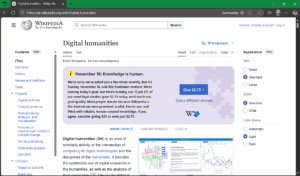
Wikipedia has been a cornerstone of the Internet since its inception as, for better or worse, a prime example of the online dissemination of information. It provides an immense corpus of data on innumerable subjects open to anyone with internet access, but it is subject to editorial controversy and undergoes continual change and revision. For complicated subjects, like this article on Digital Humanities, it is important to understand how the site works and how these articles come to be.

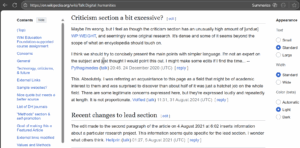
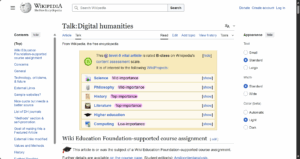
In order to navigate these inner nuances, Wikipedia offers several tools to parse the site’s structure, the first of which being the Talk page of an article. This serves as a kind of forum for editors to discuss important topics for revising, rearranging, editing, trimming, or any other kinds of changes to the article at hand. For example, this exchange details a discussion on altering the ‘Criticism’ section of the article:

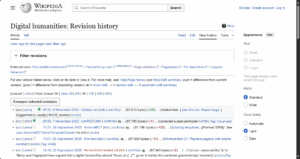
By using the Talk page, users can see which topics were brought up for discussion, which were controversial or problematic, which were added or removed or reorganized, and more. It essentially shows how the editors deliberated the current form of the article, and why they did so. In addition to the Talk page, the History page shows the entire edit history of the article from its creation (in this case, in 2007) to its current form.

This page also demonstrates important areas of editorial activity, spread across the timeframe of the article’s growth as things, such as citations and external links, are added and removed. By viewing this page, users can see which editors and contributors were involved in specific parts of the article and between which time frame they were active, allowing for a transparent view of who exactly is involved in the development of the article. Moreover, the History page naturally illustrates when certain things were changed to the article, as well as the order in which information was added, changed, or removed, oftentimes based on developments in the field for such a complicated subject as Digital Humanities.

Naturally, deconstructing a Wikipedia page, especially an informationally dense one as this, showcases how volatile the presentation of facts and knowledge can be on an open-access site such as Wikipedia. The biographies of contributors can vary widely, and the rate of changes can be rapid, making Wikipedia both an effective and cautious purveyor of information. Its unparalleled role on the Internet has made way for its new role in training AI models to crowdsource information, which opens some possibilities alongside exacerbating the existing challenges facing Wikipedia. In the reading, Jon Gertner states that none of his sources think that it is possible “to build a good A.I. model without Wikipedia,” citing its near-monopoly as an open database of knowledge, but the more it is used this way, the more likely problems will occur for both ends of the relationship (Gertner 40). Using A.I. to disseminate Wikipedia’s wealth of information not only overshadows the latter (especially when the A.I. does not cite its sources), but it carries the existing problems of Wikipedia’s editorial veracity; the A.I. can easily repeat false information spread by an unknowledgeable or malicious Wikipedia contributor. Despite the safeguards that Wikipedia attempts to maintain against malefactors, there are numerous issues that can plague both attempts at crowdsourcing information, and the above two tools illustrate that there are human elements of controversy and debate just as much as those relevant to A.I. itself. Hence, it is important to consistently understand how to deconstruct the source of one’s knowledge from origins such as Wikipedia or an L.L.M.; knowing how their answers came to be, whether through editorial debate or elsewise, will become increasingly necessary amidst the digital dissemination of knowledge.


Sources:

https://www.proquest.com/docview/2840654056?accountid=14541&parentSessionId=CB4k0B8dg5RppuRBpKekW03Dk9oY3BBua3DwOL3oLpQ%3D&sourcetype=Magazines

Network Analysis with Gephi

Compared to other digital tools such as text mining and data mapping, network analysis tools provide a more specialized way of visualizing data. As Ruth and Sebastian Ahnert explain in The Network Turn, one possible description of a network approach is that it is a way “to see features in history, language, literature, or art that would otherwise remain inscrutable;” in essence, a network highlights all possible connections, links, and other shared data that can convey broader patterns or themes. Gephi provides numerous different network graph tools, such as the standard bimodal graph:

This graph shows connections between prominent actors in early twentieth-century African American films; by viewing each node’s links, users can see which actors or movies are more prominent or what kinds of communities formed those who interacted often. The example of the Linked Jazz project demonstrates a similar approach to a network graph by showing each node with all of its potential connections, illustrating which American jazz artists knew of or interacted with each other. From there, further research can be done on what those connections mean or why they came about. Questions about specific clusters can be answered by a different approach to the network graph:

This version clearly delineates color-coded clusters within the network where certain nodes are more closely connected than with other parts of the graph. By reviewing the information specific to those nodes in the clusters, users can potentially learn how those communities were formed and why they were kept together. The Tudor Networks project demonstrates this approach by clustering nodes, representing correspondence, for each individual with specific groups or people. Each incoming or outgoing letter between people reveals factors about their relationships, which provides opportunities for further research on the nature of that communication and how those separate peoples and groups interacted. The unimodal model of network graph showcases a similar visualization of connections between groups:

By viewing these network graphs, researchers can learn about the nature of specific communications between people, groups, and communities, which allows for many wider questions on relevant social trends, issues, and problems that drive such interaction. Overall, network graphing is a specialized form of data visualization that provides valuable insight into the connections and internal interactions of a dataset.

Data Mapping with kepler.gl

Data mapping is an essential tool for visualizing data that primarily revolves around geographic elements or relations. As Presner and Shepard explain in the reading, mapping can be defined as “a king of visualization that uses levels of abstraction, scale, coordinate systems, perspective, symbology, and other forms of representation to convey a set of relations;” how the mapping tool is used can be just as important as the data being mapped. The digital mapping software kepler.gl provides numerous kinds of maps to not just display data differently, but to emphasize different things that are best shown on a map. The basic point map is the most self-explanatory: it is useful in pinpointing the distribution of the data, but the primary use is in what their geographic relations reveal. More specific mapping tool answer more specific questions, such as the cluster and heat maps. These two are specialized in demonstrating density of sources for specific regions, usually through color categorization. In the example of the Photogrammar project, each county of the United States immediately conveys how many photographic sources it contains relatively to others by its color, which immediately conveys important information to the viewer than if they were simply a pile of points. In experimenting in kepler.gl with the data from the Alabama Slave Interviews, the cluster map clearly demonstrated concentrations in urban centers such as Mobile and Birmingham. By applying the categorization tool, the map showed that those urban clusters consisted of similar shares of both ‘field’ and ‘house’ experiences, with many of the rural outliers falling into the ‘unknown’ category. Hence, these map tools can answer questions pertaining to how these different types of experiences were spread across the state and where they were found in higher numbers, and from there more research can be done with that information. Digital mapping is not constrained to geographic relation, but can also just as effectively show change over time. The time map tool in kepler.gl showed when each interview took place as well as their location, and tracking that time frame shows that the majority occurred in the late summer months of 1937, and that most of those also came from urban centers. The example of the “Tracking the Gay Guides” project illustrates how much more can be learned through time maps; by comparing the different datapoints for each year’s Address Book on a map, users can approach questions pertaining to the development of the guide’s users, community, and related establishments – where they were more common, what the main local demographic would have been, where they dissipated and where they grew over the years, etc. Overall, digital mapping is much more than simply plotting data points on a map; there are many fundamental questions about the spatial relationship of data and there are many questions that can be asked and answered using mapping.

Sources:

file:///C:/Users/lhrod/Downloads/Mapping_the_Geospatial_TurnMod8%231-1.pdf

Text Analysis With Voyant

This module introduced the concept and practice of text mining through the online program Voyant. Text mining, as the readings explained, is much more than using algorithms to find and count words; rather, it consists of numerous approaches to tracking, visualizing, and interpreting data based on a corpus of text. In the reading for one of the example text mining projects, Peter Leonard accurately compares it to a kind of close reading, a traditional humanities practice updated for digital tools: “a text-mining technique with origins in computer science actually enables more
close reading — by pointing to the needles in the haystack in the form of articles saturated with a particular discourse.”

Using excerpts from the WPA Slave Narratives dataset, Voyant allows for numerous ways of interpreting prominent aspects of the sources using text mining, the most prominent of which being through visualization. Sinclair and Rockwell define visualization as “transformations of text that tend to reduce the amount of information presented, but in service of drawing attention to some significant aspect,” and Voyant’s prime example is the Cirris word cloud, which shows how prevalent a word is based on its comparative size. Hence, this word cloud of the North Carolina interviews demonstrates that words such as ‘yankees,’ ‘house,’ and ‘marster’ were among the most common words used over those such as ‘work’ and ‘home.’

The Trends tool also works as a similar visualization tool by graphing the presence of specific words or phrases across all (or some) of the corpus. More so than the Cirrus tool, Trends allows the user to easily track where a word is more common in specific parts of the text, which may illustrate certain themes based on where and how it is used (or not used). For instance, the word ‘free’ was less common than some other distinctive words such as ‘plantation’ in most cases, except in some such as the Missouri corpus.

Moreover, Voyant provides tools for contexts of specific word usages which are naturally important for accurately tracking patterns and themes. In addition to summary tools, Voyant keeps track of the sections of the sources from which each usage of a word appears in order to better understand them. For another example, the contexts tool tracking the word ‘whipped/whupped’ shows how often it came up in the North Carolina interviews as well as what topic or issue it was tied with.

Overall, text mining with Voyant can teach numerous things about a text that may not be immediately evident. Text mining saves the individual reader or researcher by effectively analyzing a dataset for trends and themes based on the words of the text; however, it is still up to the humanist to accurately ascribe meaning and weight to those patterns as they show up.

Sources:

file:///C:/Users/lhrod/Downloads/Text_Analysis_and_Visualizationmod7.pdf

file:///C:/Users/lhrod/Downloads/Robots_Reading_Voguemod7-1.pdf

Creating Humanities Data

As much as the digital humanities is devoted to preserving and enhancing sources, it also plays a major role in the creation of data itself. To create data from humanities sources, in a broad sense, is to approach those sources with a specific goal or method in mind for reading, understanding, portraying, or otherwise perceiving the source that may not be evident as it is. As Thomas Padilla puts it, it is not “about data for data’s sake,” but instead to “to build upon our commitments to support nothing less than the ability to experience life as worth living.” Befitting the multifaceted nature of digital humanities, such data can be created in myriad ways; this module illustrated several examples of projects that created data for specific goals. For instance, the Tudor networks project digitally catalogued thousands of archived letters in order to create network maps that highlighted facts such as time frames and frequencies of correspondence between people. Moreover, the Early African American Film Database allows users to easily connect films and their production companies with respective actors, personnel, and geographic location for fuller understanding of those films’ reach and origins. If these projects all had different goals, the ensuing data would likely look and be organized differently, which echoes Miriam Posner’s point about how this kind of humanist-oriented data is different than traditional views of the word: “When you call something data, you imply that it exists in discrete, fungible units; that it is computationally tractable; that its meaningful qualities can be enumerated in a finite list; that someone else performing the same operations on the same data will come up with the same results. This is not how humanists think of the material they work with.” Instead, data from humanities sources comprises answers to questions brought up by “digital humanists – that is, people who use digital tools to explore humanities questions.”
The nature of this kind of data naturally demonstrates how important the individual process is for each endeavor; thus, transparency and communication are vital to digital humanities. Hoekstra and Koolen state that “Transparency of approach, whether digital or analogue, requires describing the activities that constitute that approach, and how they are combined in a process to generate new knowledge or ways of seeing.” This quote both summarizes the purpose of creating humanities data and emphasizing that those new perspectives are the result of the individual process at work, which must be accurately communicated. In the example of creating data with the Slave Narrative Project, it was important to immediately define the categories that data was going to be created through, such as names, locations, and dates, as well as the software that the data is supposed to be read through, in this case being a spreadsheet software such as Excel. Of course, although the scope or focus of research questions can change over time and as the data is created, the purpose of research should always be apparent and consistent. Overall, creating humanities data is an important aspect of digital humanities that must be done deliberately, meticulously, and transparently.

Sources:

Collections as Data: Conditions of Possibility | by Thomas Padilla | Medium

Data scopes for digital history research.pdf

Humanities Data: A Necessary Contradiction – Miriam Posner’s Blog

The Importance of Metadata

Thus far in this Digital Public Humanities course, we have thoroughly explored the nature of digitization and its related practices, and this module elucidated the role of metadata in the modern humanities. The transcription of analogue sources to digital formats are, as have been showcased with the photography of kitchen items, limited by their respective mediums, such as still images or videos. Key information may be lost or altered in the process based on these limitations: for example, without context a viewer would not know there was water in the tea kettle, nor that the bucket of potatoes was only labeled on one side. This is where metadata is needed to fill in these gaps in understanding; the digitized versions do not replace the original, so context is needed for the subject to be fully presented in the new electronic format. Using the common definition of “data about data,” Itza Carbajal and Michelle Caswell in the reading describe metadata as an important mode ” to find, contextualize, discover, manage, analyze, search, design, and distribute records in digital archives” because it provides the details on its origin, digitization process, source, and much more (Carbajal, Caswell 1108). This was complemented by the DPLA video from the module, which stated the importance of metadata in recording contextual information for digitized media, and especially how that information is used by archivists and others to sort through and find digitized sources.

This module’s activities in both Tropy and Omeka demonstrated the principle use of metadata: to provide necessary contextual information about the digitized photographs that would have otherwise been left behind in the process. Harkening back to an earlier module’s discussion on what is and isn’t easily depicted with photography, I was able to use metadata to describe qualities of the subjects, such as weight, texture, and overall dimensions, that are usually only measurable with the original source in hand, not the digital version. Thus, metadata is an essential component of Digital Humanities because it helps preserve information and understanding of digitized sources, so that future viewers will not be lost regarding context of the original. Digitization cannot capture or preserve everything about an analogue source, so metadata will continue to be integral to the practice of digital archiving.

Carbajal_Caswell.pdf

Using_Metadata.pdf

Database Review: Project Gutenberg

Overview and History

The foremost online repository for eBooks, Project Gutenberg is an online non-profit database dedicated to digitizing and distributing access to tens of thousands of books and other pieces of literature. Operated and published by the Project Gutenberg Literary Archive Foundation under the mission “To encourage the creation and distribution of eBooks,” this database began with early digitization efforts by founder Michael Hart in 1971 at inputting physical information into electronic text, which progressed over the years into this database. By the late-nineties, Project Gutenberg expanded into a considerable repository of electronic text and has since expanded rapidly. This database encompasses any and all books and texts digitized by its volunteers, so it is not limited to any specific time frame or subject matter; however, English and otherwise Western-oriented literature make up the dominant majority despite the overall large diversity of sources. The database is maintained from the University of North Carolina at Chapel Hill, but the actual physical copies of digitized texts vary based on their individual contributor or digitizer.

Database About page: About | Project Gutenberg

Search Functions

Project Gutenberg provides a simple but effective and highly customizable search engine for its many texts and materials. Because the majority of eBooks in this database are text scans, rather than digitized images or photocopies of pages, full text searches are available, in addition to a myriad of other search options including: sorting by language, author and/or title, non-text formats, about twenty subject areas, and datatypes and filetypes. The original catalogue has since been folded into the overall book search function as it expanded.

Database search page: Search | Project Gutenberg

Access and Citation

All eBooks digitized and distributed by Project Gutenberg are free within the public domain of the United States, given its specialty in historical texts; modern works within copyright protection are not yet accepted, although self-publishing processes are available through the World Library Foundation. All eBooks are available for download through various formats, the most common of which being the standard HTML and PDF formats, although other forms of access include through Kindle, EPUB, and others. Exportable images are available as well. Citation and bibliographic information is based on the individual source, which is always listed alongside each entry.

Download and citation page: Help on Download Options and Bibliographic Record | Project Gutenberg

Conclusions and Review

Overall, Project Gutenberg is a well-structured and easily accessible online database and an important repository for eBooks. Its search functions are simple but thorough and easy to use. Its sources are easily accessible and free to use and download in a variety of formats. Thus, as a database for public domain texts, Project Gutenberg fulfills its role and niche nicely and effectively.